
Writing a Christmas Ghost Story: A Seasonal Prompt Guide
A guide to writing festive ghost stories, with conventions of the Victorian tradition and prompts for both...

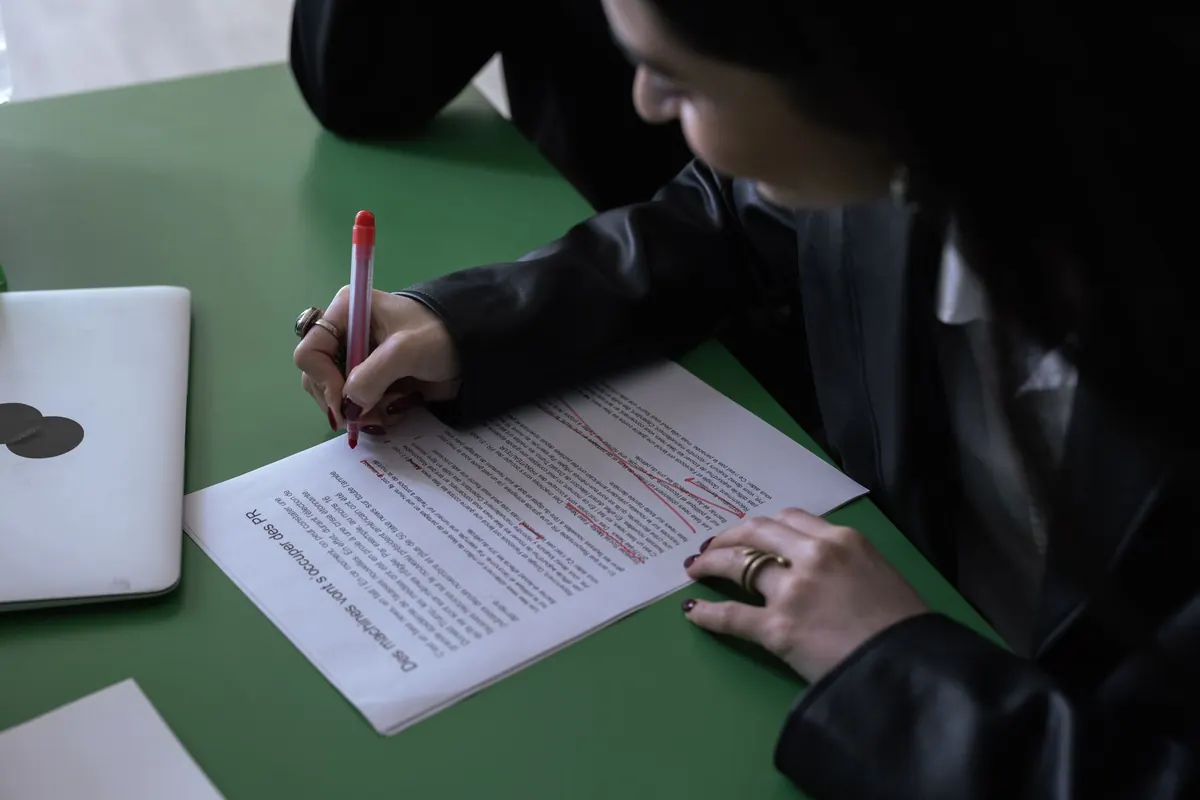
Finishing a draft brings about forty minutes of relief. Then you read a random paragraph, spot three problems in the first line, and decide the whole thing is unsalvageable. It isn't. It's a draft, and drafts are meant to be worked on.
The temptation is to fix everything at once: restructure chapter nine, rename the protagonist, delete every instance of "just". That is how a revision turns into six months of circling the same fifty pages. Give yourself one job at a time instead. Seven passes, run in sequence, each asking a single question. The order matters — there is no point polishing sentences in a scene you are about to cut.
Read the whole draft as fast as you can, in as few sittings as possible. A fast read shows you shape; a slow read only shows you sentences, which is why this pass comes first. No pen, no fixing.
Then make a chapter map: one line per chapter, saying what changes. Not what happens — what changes. "They travel to Whitby" is an event. "She admits she has been lying to her brother" is a change. Any chapter whose line contains no change is a candidate for merging or cutting.
Two questions do most of the work here. What does the protagonist want in the opening chapter, and what do they want halfway through? Those usually need to be different things. And does the ending answer the question the opening raised? If the first page asks whether she will leave, the final chapter should be about leaving, not about something that arrived in chapter twenty.
If I cut this chapter, what breaks? If the honest answer is "nothing", it is either a scene to be merged or a note to yourself that escaped onto the page.
For each scene, write down who wants what, what is in the way, and what is different by the final line. Three problems show up again and again. Scenes that could be summarised in a sentence and lose nothing. Scenes that do the same job as another scene — two arguments about the same grievance, two conversations that both establish the same secret. And scenes where characters agree with each other for a page and a half.
Conflict doesn't have to mean shouting. It can be a woman deciding whether to open an envelope. But something must be at stake, even if only for her.
Consider a scene in which two sisters argue about who drives to the hospital. On the surface, it's logistics. Underneath, they are arguing about who was there when their mother died. If the scene is only about the drive, cut it. If you can find the second layer in a line or two of dialogue, keep it and let the argument do two jobs at once.
Start with verbs. Search for "was", "were", "began to", "started to", "seemed to". Some are correct; most are hedging. "She began to cry" is weaker than "She cried". Concrete nouns beat abstractions, and one precise detail beats three vague ones. Trim pairs of adjectives to one — "a cold, grey, unforgiving sky" is doing the same work three times.
Hunt your tics with the search function, because they are invisible when you read normally. Common offenders: just, suddenly, very, a little, somehow, felt, realised. That last one is worth particular attention. "She realised she had been wrong" hands the reader a conclusion instead of letting her arrive at it.
Then listen to rhythm. Read a page aloud. If every sentence runs to roughly the same length, the page goes flat and the reader's attention drifts. Vary it: long, long, short is one pattern among many. Check paragraph openings too — five paragraphs beginning with "She" reads as mechanical, even when each sentence is fine.
Read the scene with the tags and the beats stripped out, so only speech remains. Now cover the names. Could you tell who is talking? If not, give each character a habit: one interrupts, one answers questions with questions, one goes quiet and clipped when angry.
Cut the opening pleasantries. Most conversations should begin two lines later than they currently do. Cut the recap as well — the reader was there, so characters do not need to explain the plot to each other. Keep tags simple: said, asked. Anything more colourful pulls attention to the writing rather than the exchange. A small action often replaces a tag altogether: "She set the cup down. 'No.'"
Ask what isn't being said. A scene where everyone states exactly what they mean is rarely worth the space. And be wary of spelling accents phonetically; word order, rhythm and vocabulary suggest a voice without slowing the reader to a crawl.
Pacing is the balance between scene and summary. Slow down at the turns — the confession, the betrayal, the decision — and compress the hours between them. If you dramatise a train journey and summarise the argument it caused, you have it backwards.
Pay particular attention to the last quarter. Drafts are usually thinnest there, because the ending was written in a hurry. The climax often needs more room, not less. Look at chapter endings as well: a decision, a discovery or an unanswered question will pull a reader forward. And count how many chapters open with "The next morning". Vary them, or cut straight to the action.
Keep this separate from line editing; switching between the two breaks your concentration. Make a style sheet: names and their spellings, places, ages, dates, eye colour, the layout of the flat, the car, the dog. Count the days of your timeline. Do injuries heal at a sensible rate? Are the seasons and the light consistent?
The commonest slip is knowledge. A character acts on information they haven't yet learned, or forgets something they were told in chapter four. Check point of view and tense per scene, too. If a scene slips from past to present for a paragraph, that's a mistake rather than a technique — unless you meant it, and can say why.
Your eye skips what your ear catches. Read to a wall, to a mug of tea, or use a read-aloud tool and let a synthetic voice stumble over your sentences. You will hear repeated words, accidental rhymes, sentences that run out of breath, and places where the tone wobbles. It is tedious. It is also the fastest proofreading method there is.
Finish with a mechanical sweep: double spaces, doubled words, quote marks and dashes used consistently, chapter numbers, scene-break symbols, the title page, the headers. None of it is glamorous; all of it is what a beta reader would otherwise spend their goodwill on.
Run one pass per session, or at most two, and leave days between them. Fresh eyes catch more than tired ones, and a gap of a week between the structure pass and the prose pass will show you problems you could not see while you were still inside the story.
Keep a "later" file. When you notice a continuity error mid-prose-pass, write it down and move on. Chasing it immediately is how a single afternoon disappears.
Change the format to change how you read. Print the pages, or read them on a phone instead of your laptop. Errors that have been invisible for months become obvious in a different typeface.
Set a limit per pass. If you have spent forty minutes on one paragraph, you are no longer editing, you are decorating. Move on and come back if it
Photo: cottonbro studio / Pexels
A guide to writing festive ghost stories, with conventions of the Victorian tradition and prompts for both...
Turn ordinary belongings into stories: a practical guide to freewriting plot, setting and character ideas...
Mist, harvest, bonfires and long evenings: seasonal writing prompts for cosy fiction, plus practical ways...